
This blog is no longer being updated. Posts from this blog and future small-arms related documents will be posted at the Tank Archives blog (http://tankarchives.blogspot.com) under the small arms label.
Tuesday, 1 August 2017
This Blog is Out of Service
This blog is no longer being updated. Posts from this blog and future small-arms related documents will be posted at the Tank Archives blog under the small arms label.

Monday, 15 May 2017
MKb 42 (H) vs M1 Carbine

The precision of the MKb 42(H) at ranges of 100, 300, and 500 meters is 1.5 times worse than that of the American M1 carbine.
In automatic fire, the precision of the MKb 42 (H) is unsatisfactory (a burst can't be caught by a 1.5 x 1.5 meter target at 100 meters).
The reliability of the automatic mechanism has not been determined.
The design of the sample is complex, but the widespread use of stamped parts deserves attention.
Via kris_reid.
Monday, 27 June 2016
Mauser vs Mosin
Recently, I posted the test results of a captured German Mauser sniper rifle. Without reposting the whole thing here, I'll point your attention to the important parts, namely the dispersion. As per tradition, the 50% radius is 3.6 cm at 100 meters, 15 cm at 300 meters, and 25.7 cm at 600 meters. These numbers don't change drastically with a scope on. Good, right? Well, "good" doesn't mean much without a basis of comparison. Let's compare it to a member of the same class, the Mosin 1891/30.

Those of you that have been reading my blog for a while have probably already guessed that when comparing something that has a vague reputation of quality and something that has an equally vague reputation of being cheap junk, the results can be surprising. This case is no exception: the bullet of an average AK shooter deviates by 4 cm at 100 meters, 12 cm at 300 meters, and 24 cm at 600 meters, so almost exactly the same values as a high quality German sniper rifle.

This is a scan from "Sharpshooter Manual, 7.62 mm rifle model 1891 with PU scope and optical devices", or more simply, a Mosin sniper rifle. The data seen here isn't too far off from data obtained from the German rifle: deviations of 5 cm at 100 meters, 14 cm at 300 meters, and 31-32 cm at 600 meters. As weapons of the same class, this should be expected. However, just for kicks, let's try a different weapon. One of the tables I had on hand was one for AK-74 and AKS-74 assault rifles.
Those of you that have been reading my blog for a while have probably already guessed that when comparing something that has a vague reputation of quality and something that has an equally vague reputation of being cheap junk, the results can be surprising. This case is no exception: the bullet of an average AK shooter deviates by 4 cm at 100 meters, 12 cm at 300 meters, and 24 cm at 600 meters, so almost exactly the same values as a high quality German sniper rifle.
Thursday, 26 May 2016
German Sniper Rifle

"5. Determining the combat characteristics of the German sniper rifle
The results of determining the muzzle velocity of the German sniper rifle are included in attachment #4, where you can see that the muzzle velocity of the Mauser rifle #6448 is 764 m/s.
The results of the precision and accuracy of the German sniper rifle with open and optical sights are included in attachment #5. Here are the average results.
|
|
With open sights
|
With optical sights
|
||||||
|
Dispersion radii, cm
|
Deviation from point of aiming, cm
|
Dispersion radii, cm
|
Deviation from point of aiming, cm
|
|||||
|
100%
|
50%
|
Vertical
|
Horizontal
|
100%
|
50%
|
Vertical
|
Horizontal
|
|
|
100
|
9.5
|
3.6
|
+12.5
|
+0.7
|
9.4
|
3.9
|
+1.9
|
-20.2
|
|
300
|
28.3
|
15.0
|
-17.8
|
+14.0
|
33.3
|
15.3
|
-56.7
|
-48.0
|
|
600
|
47.3
|
25.7
|
-56.3
|
+47.7
|
61.0
|
25.3
|
-165.0
|
-101.7
|
Sunday, 20 December 2015
Penetration
Penetration (or, rather, overpenetration) is an important topic for small arms as well as artillery. In this document, several different pistol rounds are compared in their ability to punch through 11 dry pine boards from a distance of 25 meters.

The guns in the list are:
- "Mod. 1930" (likely TT-30)
- Voyevodin's design
- Browning (likely Hi-Power)
- Lakhti-35
- Star 7.63 mm
- Borchardt-Luger
- Colt M1
- Mauser 7.65 mm
- Sauer
The note on the bottom says that the Star pistol was using 7.62 mm model 1930 cartridges, more commonly known as 7.62 Tokarev. As you can see, that particular pistol was the most impressive, penetrating 8 boards with 10/10 shots, and the only gun to make a hole in the 10th and 11th board. The TT-30 doesn't do as well, only conquering 6 boards, but that's still better than the .45 bullet of the 1911 (3 boards) and 9 mm Luger (4 boards).
Via kris_reid
Via kris_reid
Saturday, 17 October 2015
PTRD vs PTRS
"Evaluation of Degryaryev and Simonov anti-tank rifles based on the reviews of privates, Sergeants, and officers of anti-tank rifle units
- Simonov's rifle starts jamming after only a small amount of fouling in the chamber, after 10-15 shots. Degtyaryev's rifle is flawless in its action. I knocked out a tank near Skopishki at 300 meters (with a BO-32 bullet). - Sergeant Pazharduk, 665th Reg., 216 Div.
- The Degtyaryev anti-tank rifle has an insufficient rate of fire for fighting tanks, reloading takes too long. The rate of fire of Simonov's rifle is good, but heavy for attacking. Their weakness is that they are not used with the whole unit, but split up among companies and platoons, which removes the ability to fire in groups on tanks and other targets. BO-32 bullets have weak incendiary properties, BO-41 bullets are good. - Sergeant Pikalov, 346th. Div.
- The PTRD is an excellent weapon, works flawlessly. The PTRS jams often when there is any dirt in it or when the lubricant freezes. - Artillery Quartermaster, 1166th Reg., 346th Div. Jr. Military Technician Prikhodko
- The PTRD is flawless in battle, never has any jams that create difficulties on the battlefield. However, its weakness is that it has no magazine. The PTRS has a high rate of fire, and is convenient to carry, as it can be taken apart and put back together quickly. Its drawback is that it has many jams that cannot be fixed on the battlefield, the assembled rifle is heavy, the round casings burst often, and the chamber is fouled, which results in jams. 4 medium tanks were knocked out with anti-tank rifles from 300 meters (BO-41 bullet), and three armoured cars from 200 meters. - Artillery Quartermaster, 1168th Reg. 346th Div.
- The PTRS has sufficient rate of fire, and sufficient penetration for a light or medium tank. Its drawbacks include jamming in dusty conditions and case expansion, which makes reloading difficult.
The PTRD is light and mobile, reliable in cold and dust. The penetration is sufficient. Drawbacks include a lot rate of fire. During fighting in Lithuania and Latvia 3 tanks were knocked out at a range of 250-300 meters with incendiary bullets. - Commander, 1st Company, 1168th Reg. 346th Div. Captain Gotozhkov - The PTRD is superior to the PTRS, its penetration is good. With three aimed shots, an enemy machinegun was destroyed at 250 meters. Company commander, 346th Div. Sr. Lieutenant Deritz
- The anti-tank rifle is a good weapon for destroying enemy strongholds, armoured cars, and other weapons. - Sr. Sergeant Fedoseev
- The penetration of the anti-tank rifle at 100 meters is 45 mm. The rate of fire of the PTRS is 10-15 RPM, of the PTRD is 8-10 RPM. The rate of fire is good. The anti-tank rifle is very effective at destroying enemy machinegun nests. The anti-tank rifle likes cleanliness, good care, and constant lubrication. - Jr. Sergeant Kvichko
- Anti-tank rifle units prefer to be armed with PTRD rifles, as they are lighter and more reliable. Currently, AT rifles are rarely used against tanks, as our units are saturated with AT artillery. They are normally used to destroy cars, prime movers, and light armoured cars. - Artillery Quartermaster, 417th Div. Malinin
Conclusions
- In the second phase of the Patriotic War, when the Red Army went on the offensive on all fronts, our forces became saturated with AT artillery, improvement of armour on medium tanks and increased numbers of heavy tanks, the importance of anti-tank rifles as anti-tank weapons decreased drastically.
The anti-tank rifle lost its power as an infantry anti-tank weapon. Artillery effectively fights tanks now. The anti-tank rifle, due to its high precision, is now used against open enemy concentrations, armoured cars, and APCs. This is natural, given the state of equipment of infantry at this time. - Almost all anti-tank rifle units speak well of the PTRD: light to carry and flawless in battle. Some wish to increase its rate of fire, others mention that the rate of fire is the only good quality of the PTRS. There are no positive reviews of its reliability, only negative. After 10-15 shots, it starts jamming, and these jams are hard to fix, consume a lot of time, which is unacceptable in modern fast-paced battle.
The PTRS is unusable in battle, and its subsequent production is pointless. - Retain the PTRD in production, increase its rate of fire.
51st Army HQ Chief, Major-General Dashevskiy
Chief of the Artillery HQ, Colonel Shvedkov
September 28th, 1944"
Via artem-mr.
Tuesday, 8 September 2015
MKb 42(H) First Appearance
I wrote about Sturmgewehr intel before, but here's an even earlier appearance:

"Main data:
- Automatic fire provided by gunpowder gases passing through the gas opening.
- The barrel locks via the bolt tilting.
- Uses a special shortened round, similar to the rifle ones.
- Range: up to 800 meters.
- Has a selector for automatic and single-shot fire.
- Equipped with a bayonet for hand to hand combat."
The intelligence brief reads:
"Carbine-machinegun MK-42
The model 1942 7.92 mm carbine-machinegun with a 30-36 round special magazine (uses shortened 7.92 mm rifle bullets) is carried on a strap affixed to the stock and across from the bayonet lug. It's easy to disassemble. Judging by the design, the magazine is also used as a foregrip (there is no sign of an attachable bipod). Externally, the gun is composed of the following parts:
- Barrel
- Front sight with safety
- Gas piston pipe
- Barrel shroud
- Rear sight
- Bolt
- Magazine
- Base with pistol grip and trigger guard
- Stock with an opening for accessories
The striker mechanism of the machinegun-carbine is composed of the following parts:
- Gas piston
- Operating slide
- Bolt base
- Bolt (there is a safety on the bolt plunger and a handle for pulling it back)
The bolt is composed of the following parts:
- Bolt case
- Extractor
- Firing pin
Judging by the design of the cooling system, it can be expected that the rate of fire and automatic qualities of the machinegun-carbine are not high."
Monday, 7 September 2015
PTRS Penetration
"August 25th, 1941
To the Chair of the State Committee of Defense of the USSR, comrade Stalin I.V.
Engineer Simonov proposed an anti-tank rifle that is both simply designed and powerful. During trials at NIPSVO, the following characteristics were recorded:
To the Chair of the State Committee of Defense of the USSR, comrade Stalin I.V.
Engineer Simonov proposed an anti-tank rifle that is both simply designed and powerful. During trials at NIPSVO, the following characteristics were recorded:
- Caliber: 14.5 mm
- Mass: 21.45 kg
- Length: 2220 mm
- Muzzle velocity: 1060 m/s
- Practical rate of fire: 15 RPM
The penetration of this rifle is sufficient to fight enemy light and medium tanks, as demonstrated in the following tables:
| Range (meters) | Angle (degrees) | Armour thickness (mm) | Percentage of complete penetrations |
| Production bullet | |||
| 350 | 20 | 20 | 80% |
| Metallo-ceramic bullet | |||
| 100 | 0 | 40 | 100% |
| 200 | 0 | 35 | 100% |
| 300 | 0 | 35 | 100% |
| 700 | 0 | 30 | 100% |
| 700 | 20 | 20 | 100% |
| 1000 | 20 | 20 | 100% |
| 1200 | 20 | 20 | 50% |
| Metallo-ceramic bullet with tracer | |||
| 100 | 0 | 50 | 100% |
| 150 | 0 | 50 | 50% |
| 250 | 0 | 40 | 50% |
| 200 | 20 | 35 | 100% |
| 250 | 20 | 35 | 100% |
| 700 | 20 | 30 | 100% |
| 800 | 20 | 30 | 50% |
The German anti-tank rifle is a good mass produced measure against light tanks at ranges of up to 500 meters. Simonov's rifle, on the other hand, has superior power, rate of fire, is simpler to produce, and allows infantry to independently fight tanks at the following ranges:
- 20 mm: 1000-1200 meters
- 30 mm: 700-800 meters
- 40 mm: 200-250 meters
- 50 mm: 100-150 meters
Additionally, Simonov's rifle is self-loading, allowing firing of 5 shots in 4-5 seconds in close range tank attacks.
I think that is is necessary to take action to put Simonov's 14.5 mm anti-tank rifle into production.
Chief of the Red Army GAU, General-Colonel of Artillery, Yakovlev
Red Army GAU Military Commissar, Brigadier Commissar, Novikov"
Via gistory.
Thursday, 27 August 2015
PzB 39 Evaluation
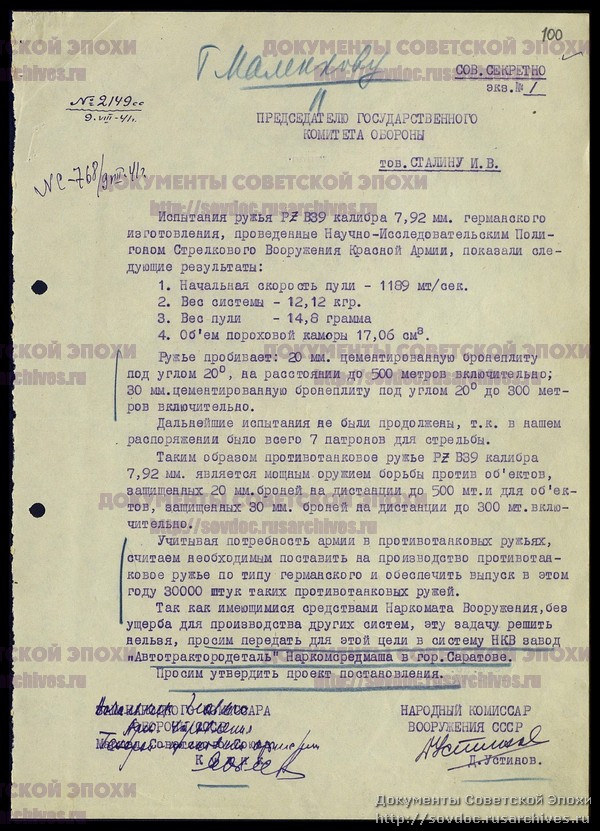
"To the Chair of the State Committee of Defense, comrade I. Stalin
Trials of the German PzB 39 7.92 mm rifle by the Red Army Small Arms Scientific Research Proving Grounds showed the following results:
- Muzzle velocity: 1189 m/s
- Mass: 12.12 kg
- Bullet mass: 14.8 grams
- Chamber volume: 17.06 cm^3
The rifle penetrates a 20 mm surface hardened plate at a 20 degree angle from 500 meters and a 30 mm surface hardened plate at a 20 degree angle from 300 meters. Further trials were not performed as only 7 rounds were available for testing.
The PzB 39 7.92 mm rifle can be considered an effective weapon against 20 mm armour at 500 meters and 30 mm armour at 300 meters. Considering the army's need of anti-tank rifles, we consider it necessary to produce at least 30,000 rifles similar to the German one annually. As it is not possible to solve this problem using the resources of the People's Commissariat of Armament without reducing production of other weapons, we ask that the "Avtotraktordetal" factory in Saratov be transferred to the NKV.
People's Commissar of Armament, D. Ustinov."
Sunday, 9 August 2015
The One with the Rifle Shoots
Somehow, the scene from Enemy at the Gates is considered real by some people, but the situation in real life was rather different. Even in blockaded Sevastopol, nobody sent soldiers to the front lines with no rifles.
"Order #03 for the second defense sector, November 19th, 1941
"Order #03 for the second defense sector, November 19th, 1941
- By order of the commander of the 31st Infantry Regiment, 43 rifles were confiscated from rear servicemen of the regiment. 43 soldiers were armed and sent to the front.
I approve of the initiative of the commander of the 31st regiment and order that:
- Immediately take inventory of all weapons in the rear forces, leave 1-2 rifles per squad and send the rest to arm the front line troops.
- The commandant of the sector HQ must confiscate weapons from rear servicemen, political department, operations department, prosecution, and tribunal.
- Immediately confiscate all submachineguns from HQs, regimental and divisional rear servicemen, political department, operations department, prosecution, tribunal, medical units and drivers, send them to:
- Regiments: to front line companies and reconnaissance units.
- Divisions; to the chief of artillery armament, comrade Oskin.
- I must ask commanders and commissars to pay attention to some soldiers that, when the enemy pressures them, retreat and throw down their rifles and even machineguns.
I demand the strictest responsibility of soldiers and commanders for the weapons given to them. Those that abandon their weapons will be brought before a military tribunal. Form small squads headed by a brave unit commander to retrieve weapons from the dead and heavily wounded in each company. Each rifle and especially machinegun must be saved no matter what."
Via gistory.
Saturday, 20 June 2015
Wonder Bullet
"Act
On July 6th, 1941, based on the orders of the OTB chief, Major of State Security comrade Kravchenko and GAU KA chief, Colonel-General comrade Yakovlev we, [long list of commission members] performed trials of 7.62 mm AP-I bullets with a ceramic-metallic core and gunpowder developed by the OTB NKVD at the OTB NKVD proving grounds to establish their effectiveness.
Experimental rounds of two types were submitted for trials. One type had 4.15 grams of propellant, the other 4.2 grams. Characteristics of the rounds are shown in attachment #3.
Trials were performed against 20 mm surface hardened armour (see characteristics in attachment #1) with the air temperature of 28-29 degrees and range of 100 and 150 meters.
The following bullets were used to test the quality of the armour plate and compare the effectiveness of experimental bullets:
On July 6th, 1941, based on the orders of the OTB chief, Major of State Security comrade Kravchenko and GAU KA chief, Colonel-General comrade Yakovlev we, [long list of commission members] performed trials of 7.62 mm AP-I bullets with a ceramic-metallic core and gunpowder developed by the OTB NKVD at the OTB NKVD proving grounds to establish their effectiveness.
Experimental rounds of two types were submitted for trials. One type had 4.15 grams of propellant, the other 4.2 grams. Characteristics of the rounds are shown in attachment #3.
Trials were performed against 20 mm surface hardened armour (see characteristics in attachment #1) with the air temperature of 28-29 degrees and range of 100 and 150 meters.
The following bullets were used to test the quality of the armour plate and compare the effectiveness of experimental bullets:
- Stock rounds with B-32 bullets.
- Rounds with 3.15 grams of propellant and a metallic-ceramic core.
- Rounds with 4.2 grams of experimental gunpowder and B-32 bullets.
These bullets were fired at 50 meters, as firing them from larger ranges made no sense due to their ineffectiveness against 20 mm of surface hardened armour from even 50 meters. Results are contained in the following table:
| Hits | Complete penetrations | Incomplete penetrations | Complete penetrations, part of bullet is stuck | % penetrations | |
| Stock round with B-32 bullet | 5 | 0 | 51 | 0 | |
| Experimental round with B-32 bullet | 5 | 0 | 51 | 0 | |
| Experimental round with metallic-ceramic bullet (w=3.15) | 5 | 0 | 52 | 0 | |
| Experimental round with metallic-ceramic bullet (w=4.15) | 5 | 3 | 2 | 100 | |
| 21 | 3 | 13 | 21 | 95.2 | |
| Experimental round with metallic-ceramic bullet (w=4.2) | 5 | 3 | 2 | 100 |
Notes:
- Dents on one side, no effect on the other side.
- Three hits caused bulges on the rear side, two had the bullet tip penetrate completely.
- The bullet tip penetrated completely.
In order to test the incendiary action of the bullets, experimental rounds (w=4.2) were fired from a range of 150 meters at a 20 mm plate with a full gasoline tank up against it. As a result, the gasoline ignited from the first shot that hit the gasoline (the first shot that was fired hit above the gasoline). Both bullets penetrated the armour completely.
Conclusions
- The effectiveness of the experimental OTB NKVD rounds is superior to all currently known 7.62 mm armour piercing incendiary bullets.
- The results should be immediately checked at NIPSVO to establish ballistic norms and more carefully establish the armour penetration effectiveness. For this purpose, USV GAU should produce 500 bullets with ceramic-metallic cores by July 6th, 1941, and OTB NKVD must assemble them and send them to NIPSVO by July 7th, 1941.
- Due to good results of trials, do not wait for NIPSVO trials to complete and begin production with existing propellant. USV GAU must provide the bullets for this batch. The batch must be complete by July 15th, 1941.
- NKO must give the order to NKB for production of the gunpowder developed by the OTB NKVD at factory #40 in the amount of 7-10 tons, and NKV must set up production of 7.62 mm bullets with ceramic-metallic cores at factory #188.
- Calculate the propellant load with the aim to produce average pressure less than 3200 kg/cm^2 as both rounds tested had similar results."
Thursday, 19 February 2015
AK Muzzle Devices
The accuracy of an automatic weapon is important, and many experiments were run on the AK platform to figure out if it can be increased. A number of experimental muzzle devices were built for this purpose. _tezka provided this picture.


Left to right: similar to stock type, brake-compensator, two chamber, flash suppressor, single chamber, reactive.
While all of these successfully reduced muzzle climb and improved accuracy, there was one important drawback that engineers did not necessarily consider...
"The positive effect of the muzzle brake on the accuracy is at odds with the negative result of the sound wave hearing, which is greatly increased to unacceptable levels with most muzzle brakes.
...
The evaluation of the effect of the sound waves on hearing reveals that all muzzle brakes in the table result in a bothersome or painful sensation in the ears."
A DShK style reflector was considered to remedy this effect, but...
"...a reflector of such size can hardly be recommended as they decrease the maneuverability and comfort of the weapon and do not achieve the intended result of reducing the sound to a level that does not cause pain."
Another device was tested to improve accuracy, but it was a different kind of brake.
Curiously enough, it was a brake for the bolt. The experiment was meant to determine the effect of the speed of the bolt flying back and forth on accuracy. The knobs on the sides could adjust the force applied to the bolt in order to slow it down.
Sunday, 28 December 2014
AK Precision
"Characteristics of dispersion for Kalashnikov assault rifles (AK-74 and AKS-74)
Bullet with a steel core
Shooting in short bursts, while prone"

The table is split into two sections. The section on the left is for a well trained shooter, the section on the right is for an average shooter. For each section, the dispersion is first given for the first bullet in the burst (height, then width), then for the subsequent bullets. The first two columns in the subsequent section are for the bullet itself. The second two are for the average point of impact between all hits. The last two columns are the total dispersion.
The notes in the bottom remark that the table is also valid for shooting at night, within the range of the night vision scope, and when firing single shots, the dispersion in the first two columns (first bullet of burst) is valid.
Thursday, 30 October 2014
Sturmgewehr Usage
Some of you may have wondered when the Soviets noticed that the Sturmgewehr has joined the arsenal of German infantry. Wonder no more! Via kris-reid:

Since the Spring of this year, forces of the Kalinin, and then Volkhov and Leningrad Fronts have captured, among other weapons, several specimens of new German automatic 7.92 mm carbines, which are a new type of infantry weapon that has not been previously used by the Germans in large amounts until recently."
The date on this document is April 16th, 1943. Here's the intel obtained on this mysterious weapon:

"Enemy tactics and technology
Engineer-Captain Ya. Krutik
1. New German handheld machinegun
The machinegun can fire automatically or in single shots, for which a switch is present in the trigger guard, next to the pistol grip.
The machinegun is fed with a box magazine, which holds 35-38 rounds.
- Caliber: 7.9 mm
- Length: 935 mm
- Mass: about 5 kg
- Round mass: 16.8 g
- Bullet mass: 8.2 g"
The translator was a little presumptuous. "MKb" stands for Maschinen Karabiner, or machine carbine. Also, the magazine capacity has grown somewhat from the 30 rounds it actually contained. Otherwise, this intelligence is correct.
Saturday, 25 October 2014
High Capacity
I am sure that many of you have seen those comedic 100-round magazines for AK assault rifles that can barely feed 5 or 6 without jamming up. What you probably didn't know is that the idea isn't exactly new.

These photos are from magazine trials of 30, 40, 50, and 100 rounds.
Tuesday, 14 October 2014
Precision Comparison
In 1948, it was clear that the PPSh has served its time, and a new, more powerful automatic infantry weapon was necessary, using an intermediate 7.62x39 mm mod. 1943 cartridge. Several weapons were designed to Tactical-Technical Specification #3131 and tested along with their submachinegun ancestor and the German Sturmgewehr for comparison.

The columns represent the radii of dispersion for bursts while prone and single fire while prone. R100 gives the full radius, and Ч50 gives the mean radius. The rifles are as follows:
- AS-44 type 7 (with 3 vent openings)
- AS-44 (no changes)
- Kalashnikov assault rifle
- Dementyev assault rifle
- Bulkin assault rifle
- Korobov assault rifle
- Submachinegun model 1941 (PPSh)
- MP-44 (Sturmgewehr)
And the last row is the precision requirement. The summary reads:
"The AS-44 with vent openings (type 7) surpasses all other assault rifles: in Ч50 by 2-4 times, and in R100 by 2.3-7 times. The precision when firing in full auto mode matches requirements."
It is also interesting to note that the famous Kalashnikov made the list. Despite being less precise than the modified AS-44 and failing TTT#3131, the weapon surpasses the Sturmgewehr in all criteria except single fire mode while prone, where the latter has a slight advantage.
Sunday, 13 July 2014
Science Fiction
Sometimes, inventions that are sent in to the military seem pretty impressive. Like this one!


"Comrade Lyadov proposes a super-speedy anti-tank rifle, where the propellant burns as fast as possible, and the bullet is propelled primarily through adiabatic expansion of gases. In order to achieve acceptable pressures, the inventor uses low propellant density. With heavy projectiles, the inventor hopes to maximize the Pcp/Pm ratio and achieve muzzle velocity of 3400 m/s.
In order to achieve a chamber large enough, which the inventor says will need to be bigger than the size of the rifled section of the gun, the inventor proposes a two-piece chamber. One of them is a regular chamber, another, connected to the first, is underneath the barrel. The propellant, as can be assumed from the proposal, all fits in the first chamber."
3400 m/s! Pretty impressive. Of course, there is always a catch.
"When evaluating comrade Litvinov's proposal, it must be noted that the aforementioned muzzle velocity (3400 m/s) was obtained after making critical mistakes in the calculations, which makes the ballistic portion of his project a sad misunderstanding."
Tuesday, 1 July 2014
AK Trials

"Conclusions:
- The 7.62 mm Kalashnikov assault rifle with a model 1943 round satisfies requirement #3131 in reliability of the automatic system, lifespan of components, usage characteristics, and overall, and can be recommended for mass production and subsequent military trials.
- The Kalashnikov assault rifle does not fully satisfy requirement #3131 in the category of precision. However, as when firing single shots it greatly surpasses the model 1941 SMG, and is equivalent when firing in fully automatic mode, the Kalashnikov assault rifle can be recommended for military trials with existing precision.

Recommendations:
- Assault rifles, produced according to requirement #3132, which were composed according to military suggestions after AS-44 trials and previous proving grounds trials, are a step forward compared to the AS-44 as assault rifles matching modern requirements.
- The best performance of all was by the Kalashnikov assault rifle, which, due to its reliability, component lifespan, and overall, satisfies the requirements, and can be recommended for mass production and military trials with its existing precision, as it is not less than the precision of the AS-44, and the assault rifle surpasses the PPSh-41 in all characteristics."
Tezka also has some more details on the trials. The comparison was between the new Kalashnikov, Bulkin, and Dementyev rifles, compared with the PPSh, PPS, and MP-44. Also, more results:
"When firing in bursts while prone, all assault rifles are equivalent, do not satisfy requirement #3131, and are inferior to the model 1941 submachinegun.
...
When firing in single shot, all are superior to the model 1941 submachinegun, and likewise equivalent."
Additionally, he states that, ergonomically, all assault rifles were superior to the PPSh-41.
Friday, 27 June 2014
DP Autoloader
Ever tried loading Degtaryev disk magazines by hand? I have, and it's not exactly a pleasant experience. Various devices exist to ease this process. Sadly, they weren't perfect.


"Photo #5: Overall view of Abramov's loader without the feeder or disk.
Photo #6: Filling of a magazine using Abramov's loader. The feeder is disconnected (rounds are fed by hand)
Photo#7: Damage to rounds that jammed in the magazine during loading.
Damaged rounds when loading DP magazines with Koshin's loader.
And another fun one (no indication of what system it "belongs" to):
Sunday, 16 March 2014
Shooting from Horseback
Yuri Pasholok got his hands on a pile of old military manuals recently, including Shooting from Horseback. It's a somewhat lengthy book, so I'm not going to translate all of it, just interesting bits.
"Peculiarities of firing from horseback
If firing a rifle from horseback is done mainly during patrols and other cases when there is no time to dismount, firing a revolver or pistol is often done by a cavalryman.
In battle, commanding fire from horseback is either very difficult or downright impossible. The soldier must rapidly and independently determine how to act, with a blade or revolver, and if the latter, fire, select targets, find an aiming points, etc. Actions of a cavalryman are further complicated by allied cavalry mixing with enemy cavalry. The cavalryman must fire in a way that does not injure his allies.
These peculiarities must be considered when teaching soldiers to handle their weapons. A soldier's ability to fight independently or in a group, display creativity and initiative, and knowledge of ballistics of his weapons are fundamentals of his training.
The issue of shooting from horseback was first explored in the Manual for Shooting from Horseback, published in 1935. That manual demands that every cavalryman must master techniques of firing from horseback with a rifle, pistol, or revolver.
In this work, we make it our objective to share with the writer the practical and theoretical conclusions we have reached as a result of trials.
Trials show that the most effective rifle fire is at a target 100-150 meters away from the rider. Individual riders may effectively engage targets at larger distances. Fire from a revolver is effective at 50 meters when stopped and 35 meters on the move. A group of shooters may engage a target 75 meters away when stationary and 50 meters away on the move.
Precision of firing from horseback is affected by many factors that firing from the ground is not. It is dependent on, for example, the behaviour of the horse. The horse often impedes its rider's ability to shoot precisely, which is why every cavalryman must dedicate much attention to the training of his horse."
The next section has to do with preparation and training of the horse, which isn't particularly relevant. The next section, however, is: loading!
"Loading, preparation, and readying to fire from a pistol or revolver
In all cases, when the cavalryman's weapon is unloaded, load it according to NSD-3 when the command "Load!" is given. Keep your left hand on the reins and do not loosen its grasp.
While reloading on the move on horseback, the rider, without letting go of the reins, moves the revolver to his left hand, and with the index finger of his left hand, presses the magazine release. With his right hand, he catches the empty magazine and places it in his pocket or under his belt. Then he extracts a full magazine and inserts it into his pistol, all the way forward until a click is heard.
After that, the rider puts his right index finger and thumb on the rear of the slide, pulls it back quickly, and releases it (the finger should not be inside the trigger guard during this process). If there is no need to fire immediately, the rider puts his safety on and places the revolver in his holster."
A revolver with a magazine? This is a peculiarity of the Russian language in the interbellum period. Revolvers (namely the Nagant) have been the name of the game for a very long time, and self-loading pistols have only started appearing relatively recently. The term "revolver" is applied even to the Mauser C96 pistol in some Russian language manuals of this era. Delays in this new term spreading led to strange Finnish propaganda leaflets during the Winter War, talking about "self-loading revolvers" (pistols) and "fast-firing revolvers" (submachineguns).
"When the command "Ready to fire from horseback!" is given, the rider extracts his pistol or revolver from the holster, bends his right arm at the elbow, and holds it muzzle up to the right, at about chin level. The safety is off (fig. 1).
The positions for firing from a pistol or revolver are as follows: front (half-turn left and right) and back (half-turn left and right). In the event that the rider shoots forward, the rider gathers up the reins and sends the horse in a wide gallop. He then lifts himself up, puts his body forward, and raises the pistol or revolver above the horse's head (fig 2).

If it is necessary to shoot at a lying target, the rider points his gun downward on the right or left side of the horse. In order to not deafen the horse, the hand must be kept as far away from the horse's head as possible (fig. 3).
When shooting half-turned, the rider gathers the reins, braces his left hand against his horse, and increases the pressure on the stirrups. He then turns towards the target and sends the horse into a wide gait (up to 8 m/s).
When shooting left or right, the rider gathers the reins and sends the horse forward. With his left hand, he braces against the horse, increases pressure on the stirrups, and leans towards his target (fig. 4).

Of all the above positions, the most comfortable ones are shooting right, half-turned, or forward. The most difficult ones are shooting to the left and backwards. This leads to the conclusion that when shooting from horseback with a pistol or revolver, the rider must always position himself favourably against the enemy. If necessary, he must change the direction of movement. When shooting from a stationary position, rotate the horse into an advantageous position for firing.
Aiming and Pulling the Trigger of a Revolver of Pistol
The success of a shot depends on a smooth, and, at the same time, swift pull of the trigger. Shooting from a horse is shooting with open sights, which must be practiced with long and systematic training, both on horseback and on the ground.
When shooting from a stationary position, aim just as you would on the ground, through the center of the sights to the target. Here, the rider must only be careful to ensure that the shot coincides with the horse's exhaling.
Shooting from a horse in motion has its own problems, and differs greatly from shooting on the ground. Constant movement of the horse does not let the rider to line up his sights, as they jump around.
Due to these causes, aiming should be done not through the sights, but using the upper surface of the barrel. The sight line with this aiming will go above normal aiming. This is caused by an angle forming between the sight line and the barrel. At various distances, the deviation changes."
The rest of the chapter is simple math to figure out how low you have to aim, but there is a handy summary.
"The following diagram indicates that the vertical aim point should be as follows:
"Peculiarities of firing from horseback
If firing a rifle from horseback is done mainly during patrols and other cases when there is no time to dismount, firing a revolver or pistol is often done by a cavalryman.
In battle, commanding fire from horseback is either very difficult or downright impossible. The soldier must rapidly and independently determine how to act, with a blade or revolver, and if the latter, fire, select targets, find an aiming points, etc. Actions of a cavalryman are further complicated by allied cavalry mixing with enemy cavalry. The cavalryman must fire in a way that does not injure his allies.
These peculiarities must be considered when teaching soldiers to handle their weapons. A soldier's ability to fight independently or in a group, display creativity and initiative, and knowledge of ballistics of his weapons are fundamentals of his training.
The issue of shooting from horseback was first explored in the Manual for Shooting from Horseback, published in 1935. That manual demands that every cavalryman must master techniques of firing from horseback with a rifle, pistol, or revolver.
In this work, we make it our objective to share with the writer the practical and theoretical conclusions we have reached as a result of trials.
Trials show that the most effective rifle fire is at a target 100-150 meters away from the rider. Individual riders may effectively engage targets at larger distances. Fire from a revolver is effective at 50 meters when stopped and 35 meters on the move. A group of shooters may engage a target 75 meters away when stationary and 50 meters away on the move.
Precision of firing from horseback is affected by many factors that firing from the ground is not. It is dependent on, for example, the behaviour of the horse. The horse often impedes its rider's ability to shoot precisely, which is why every cavalryman must dedicate much attention to the training of his horse."
The next section has to do with preparation and training of the horse, which isn't particularly relevant. The next section, however, is: loading!
"Loading, preparation, and readying to fire from a pistol or revolver
In all cases, when the cavalryman's weapon is unloaded, load it according to NSD-3 when the command "Load!" is given. Keep your left hand on the reins and do not loosen its grasp.
While reloading on the move on horseback, the rider, without letting go of the reins, moves the revolver to his left hand, and with the index finger of his left hand, presses the magazine release. With his right hand, he catches the empty magazine and places it in his pocket or under his belt. Then he extracts a full magazine and inserts it into his pistol, all the way forward until a click is heard.
After that, the rider puts his right index finger and thumb on the rear of the slide, pulls it back quickly, and releases it (the finger should not be inside the trigger guard during this process). If there is no need to fire immediately, the rider puts his safety on and places the revolver in his holster."
A revolver with a magazine? This is a peculiarity of the Russian language in the interbellum period. Revolvers (namely the Nagant) have been the name of the game for a very long time, and self-loading pistols have only started appearing relatively recently. The term "revolver" is applied even to the Mauser C96 pistol in some Russian language manuals of this era. Delays in this new term spreading led to strange Finnish propaganda leaflets during the Winter War, talking about "self-loading revolvers" (pistols) and "fast-firing revolvers" (submachineguns).
"When the command "Ready to fire from horseback!" is given, the rider extracts his pistol or revolver from the holster, bends his right arm at the elbow, and holds it muzzle up to the right, at about chin level. The safety is off (fig. 1).
The positions for firing from a pistol or revolver are as follows: front (half-turn left and right) and back (half-turn left and right). In the event that the rider shoots forward, the rider gathers up the reins and sends the horse in a wide gallop. He then lifts himself up, puts his body forward, and raises the pistol or revolver above the horse's head (fig 2).
If it is necessary to shoot at a lying target, the rider points his gun downward on the right or left side of the horse. In order to not deafen the horse, the hand must be kept as far away from the horse's head as possible (fig. 3).
When shooting half-turned, the rider gathers the reins, braces his left hand against his horse, and increases the pressure on the stirrups. He then turns towards the target and sends the horse into a wide gait (up to 8 m/s).
When shooting left or right, the rider gathers the reins and sends the horse forward. With his left hand, he braces against the horse, increases pressure on the stirrups, and leans towards his target (fig. 4).
Of all the above positions, the most comfortable ones are shooting right, half-turned, or forward. The most difficult ones are shooting to the left and backwards. This leads to the conclusion that when shooting from horseback with a pistol or revolver, the rider must always position himself favourably against the enemy. If necessary, he must change the direction of movement. When shooting from a stationary position, rotate the horse into an advantageous position for firing.
Aiming and Pulling the Trigger of a Revolver of Pistol
The success of a shot depends on a smooth, and, at the same time, swift pull of the trigger. Shooting from a horse is shooting with open sights, which must be practiced with long and systematic training, both on horseback and on the ground.
When shooting from a stationary position, aim just as you would on the ground, through the center of the sights to the target. Here, the rider must only be careful to ensure that the shot coincides with the horse's exhaling.
Shooting from a horse in motion has its own problems, and differs greatly from shooting on the ground. Constant movement of the horse does not let the rider to line up his sights, as they jump around.
Due to these causes, aiming should be done not through the sights, but using the upper surface of the barrel. The sight line with this aiming will go above normal aiming. This is caused by an angle forming between the sight line and the barrel. At various distances, the deviation changes."
The rest of the chapter is simple math to figure out how low you have to aim, but there is a handy summary.
"The following diagram indicates that the vertical aim point should be as follows:
- Pistol:
- Ground target: groin
- Horseback target: horse's chest
- Revolver:
- Ground target: knees
- Horseback target: horse's knees"
The chapter after this is composed of mathematical tables for compensating for the horse's speed when moving. Basically, aim a little bit in front of the target, since the horse will have moved you over to the proper place by the time you pulled the trigger. The revolver and pistol in question are obviously the Nagant and Tokarev. You will have to do your own calculations for other handguns.
There is also the dispersion for the Nagant. There is no table for a pistol, but the book promises that it is not more than 2-3 cm different.
There is also the dispersion for the Nagant. There is no table for a pistol, but the book promises that it is not more than 2-3 cm different.
| Distance in meters | 15 | 25 | 35 | 50 | ||
| In place | Dispersion in cm | Best half (50%) | 8 | 11 | 15 | 21 |
| Full dispersion (100%) | 14 | 20 | 30 | 42 | ||
| While moving | Dispersion in cm | Best half (50%) | 18 | 41 | 52 | 75 |
| Full dispersion (100%) | 38 | 63 | 99 | 135 | ||
Readying, Loading, and Holding a Rifle
Ready your rifle when the "Rifles!" command is given. When this command is given, the soldier grabs the strap with his right hand and slips his elbow under the rifle (fig. 16). Then, he grabs the grooves, moves the rifle up, and flips the strap over his head. Having removed his rifle, the soldier puts its stock on his right thigh, moves its barrel upwards, loosens his reins in his left hand, and grabs the rifle with that same hand (fig. 17).

In cases when the rifle is not loaded, the soldier loads it when the "Load!" command is given according to rules in NSD-1. He must be careful to not point the rifle downwards at any time. After shooting is finished, the soldier takes the rifle strap in the middle with his right hand, flips it over his head with a swift motion, and lowers his hand (fig. 18).

Shooting from a rifle is done when half-turned right, to the right, half-turned left, to the left, and to the rear. The most comfortable positions are half-turned to the left and forward. When preparing to fire half-turned to the right or left, the rider sits deeply in his saddle, turns his waist left or right (figs. 19 and 20), puts his stock to his shoulder, grabs the rifle with his right hand, and lifts it to his shoulder. The left hand holds the rifle underneath the sights and holds the lengthened reins. Do not loosen the reins too much, as the rider must feel the horse after a shot, and control him in case of unruliness."

Shooting in other directions is largely the same.
Shooting from a horse is done largely the same as with a pistol, except with a rifle, you use the sights. A difference from normal rifle shooting is that the bayonet is not mounted. When the bayonet is not mounted, keep in mind the deviations of the bullet.
Ready your rifle when the "Rifles!" command is given. When this command is given, the soldier grabs the strap with his right hand and slips his elbow under the rifle (fig. 16). Then, he grabs the grooves, moves the rifle up, and flips the strap over his head. Having removed his rifle, the soldier puts its stock on his right thigh, moves its barrel upwards, loosens his reins in his left hand, and grabs the rifle with that same hand (fig. 17).
In cases when the rifle is not loaded, the soldier loads it when the "Load!" command is given according to rules in NSD-1. He must be careful to not point the rifle downwards at any time. After shooting is finished, the soldier takes the rifle strap in the middle with his right hand, flips it over his head with a swift motion, and lowers his hand (fig. 18).
Shooting from a rifle is done when half-turned right, to the right, half-turned left, to the left, and to the rear. The most comfortable positions are half-turned to the left and forward. When preparing to fire half-turned to the right or left, the rider sits deeply in his saddle, turns his waist left or right (figs. 19 and 20), puts his stock to his shoulder, grabs the rifle with his right hand, and lifts it to his shoulder. The left hand holds the rifle underneath the sights and holds the lengthened reins. Do not loosen the reins too much, as the rider must feel the horse after a shot, and control him in case of unruliness."
Shooting in other directions is largely the same.
Shooting from a horse is done largely the same as with a pistol, except with a rifle, you use the sights. A difference from normal rifle shooting is that the bayonet is not mounted. When the bayonet is not mounted, keep in mind the deviations of the bullet.
Distance (m)
|
Deviation
|
|
Up
|
Right
|
|
100
|
11 cm
|
10 cm
|
200
|
22 cm
|
20 cm
|
"As you can see from the table, the rider has a small chance to strike a small target with these deviations, but shooting from horseback is done in exceptional cases only, and should not be done against small targets. It is clear that in this case, a rider may be disabled much faster than the target that he is aiming at."
The next chapter deals with leading your shot when shooting to the side, and is largely mathematical tables.
"Conclusions.
In this book, we aimed to answer questions associated with our investigations. It cannot be said that that we fully solved all questions of shooting from horseback, but practical things can be extracted from the above material.
- First of all, your horse must be ready for shooting. Working with your horse must have a systematic and well thought out character.
- Training the horse is not enough. The rider must be trained. Only a good rider may shoot well from a horse.
- An individual rider may strike a target 50 meters away when still, 35 when. A group of shooters may shoot up to 75 meters. Using a rifle, a single shooter may fire at a target 100 meters away.
- Shooting from a horse must be done when there is no time to dismount, an at large targets.
Shooting at large distances is ineffective due to high dispersion."
Subscribe to:
Posts (Atom)