Showing posts with label anti-tank rifle. Show all posts

Saturday, 17 October 2015

PTRD vs PTRS

"Evaluation of Degryaryev and Simonov anti-tank rifles based on the reviews of privates, Sergeants, and officers of anti-tank rifle units

  1. Simonov's rifle starts jamming after only a small amount of fouling in the chamber, after 10-15 shots. Degtyaryev's rifle is flawless in its action. I knocked out a tank near Skopishki at 300 meters (with a BO-32 bullet). - Sergeant Pazharduk, 665th Reg., 216 Div.
  2. The Degtyaryev anti-tank rifle has an insufficient rate of fire for fighting tanks, reloading takes too long. The rate of fire of Simonov's rifle is good, but heavy for attacking. Their weakness is that they are not used with the whole unit, but split up among companies and platoons, which removes the ability to fire in groups on tanks and other targets. BO-32 bullets have weak incendiary properties, BO-41 bullets are good. - Sergeant Pikalov, 346th. Div.
  3. The PTRD is an excellent weapon, works flawlessly. The PTRS jams often when there is any dirt in it or when the lubricant freezes. - Artillery Quartermaster, 1166th Reg., 346th Div. Jr. Military Technician Prikhodko
  4. The PTRD is flawless in battle, never has any jams that create difficulties on the battlefield. However, its weakness is that it has no magazine. The PTRS has a high rate of fire, and is convenient to carry, as it can be taken apart and put back together quickly. Its drawback is that it has many jams that cannot be fixed on the battlefield, the assembled rifle is heavy, the round casings burst often, and the chamber is fouled, which results in jams. 4 medium tanks were knocked out with anti-tank rifles from 300 meters (BO-41 bullet), and three armoured cars from 200 meters. - Artillery Quartermaster, 1168th Reg. 346th Div.
  5. The PTRS has sufficient rate of fire, and sufficient penetration for a light or medium tank. Its drawbacks include jamming in dusty conditions and case expansion, which makes reloading difficult.
    The PTRD is light and mobile, reliable in cold and dust. The penetration is sufficient. Drawbacks include a lot rate of fire. During fighting in Lithuania and Latvia 3 tanks were knocked out at a range of 250-300 meters with incendiary bullets. - Commander, 1st Company, 1168th Reg. 346th Div. Captain Gotozhkov
  6. The PTRD is superior to the PTRS, its penetration is good. With three aimed shots, an enemy machinegun was destroyed at 250 meters. Company commander, 346th Div. Sr. Lieutenant Deritz
  7. The anti-tank rifle is a good weapon for destroying enemy strongholds, armoured cars, and other weapons. - Sr. Sergeant Fedoseev
  8. The penetration of the anti-tank rifle at 100 meters is 45 mm. The rate of fire of the PTRS is 10-15 RPM, of the PTRD is 8-10 RPM. The rate of fire is good. The anti-tank rifle is very effective at destroying enemy machinegun nests. The anti-tank rifle likes cleanliness, good care, and constant lubrication. - Jr. Sergeant Kvichko
  9. Anti-tank rifle units prefer to be armed with PTRD rifles, as they are lighter and more reliable. Currently, AT rifles are rarely used against tanks, as our units are saturated with AT artillery. They are normally used to destroy cars, prime movers, and light armoured cars. - Artillery Quartermaster, 417th Div. Malinin
Conclusions
  1. In the second phase of the Patriotic War, when the Red Army went on the offensive on all fronts, our forces became saturated with AT artillery, improvement of armour on medium tanks and increased numbers of heavy tanks, the importance of anti-tank rifles as anti-tank weapons decreased drastically.
    The anti-tank rifle lost its power as an infantry anti-tank weapon. Artillery effectively fights tanks now. The anti-tank rifle, due to its high precision, is now used against open enemy concentrations, armoured cars, and APCs. This is natural, given the state of equipment of infantry at this time.
  2. Almost all anti-tank rifle units speak well of the PTRD: light to carry and flawless in battle. Some wish to increase its rate of fire, others mention that the rate of fire is the only good quality of the PTRS. There are no positive reviews of its reliability, only negative. After 10-15 shots, it starts jamming, and these jams are hard to fix, consume a lot of time, which is unacceptable in modern fast-paced battle.
    The PTRS is unusable in battle, and its subsequent production is pointless.
  3. Retain the PTRD in production, increase its rate of fire.
51st Army HQ Chief, Major-General Dashevskiy
Chief of the Artillery HQ, Colonel Shvedkov
September 28th, 1944"


Via artem-mr.

Monday, 7 September 2015

PTRS Penetration

"August 25th, 1941
To the Chair of the State Committee of Defense of the USSR, comrade Stalin I.V.

Engineer Simonov proposed an anti-tank rifle that is both simply designed and powerful. During trials at NIPSVO, the following characteristics were recorded:
  • Caliber: 14.5 mm
  • Mass: 21.45 kg
  • Length: 2220 mm
  • Muzzle velocity: 1060 m/s
  • Practical rate of fire: 15 RPM
The penetration of this rifle is sufficient to fight enemy light and medium tanks, as demonstrated in the following tables:

Range (meters)Angle (degrees)Armour thickness (mm)Percentage of complete penetrations
Production bullet
350202080%
Metallo-ceramic bullet
100040100%
200035100%
300035100%
700030100%
7002020100%
10002020100%
1200202050%
Metallo-ceramic bullet with tracer
100050100%
15005050%
25004050%
2002035100%
2502035100%
7002030100%
800203050%

The German anti-tank rifle is a good mass produced measure against light tanks at ranges of up to 500 meters. Simonov's rifle, on the other hand, has superior power, rate of fire, is simpler to produce, and allows infantry to independently fight tanks at the following ranges:
  • 20 mm: 1000-1200 meters
  • 30 mm: 700-800 meters
  • 40 mm: 200-250 meters
  • 50 mm: 100-150 meters
Additionally, Simonov's rifle is self-loading, allowing firing of 5 shots in 4-5 seconds in close range tank attacks. 

I think that is is necessary to take action to put Simonov's 14.5 mm anti-tank rifle into production.

Chief of the Red Army GAU, General-Colonel of Artillery, Yakovlev
Red Army GAU Military Commissar, Brigadier Commissar, Novikov"

Via gistory.

Thursday, 27 August 2015

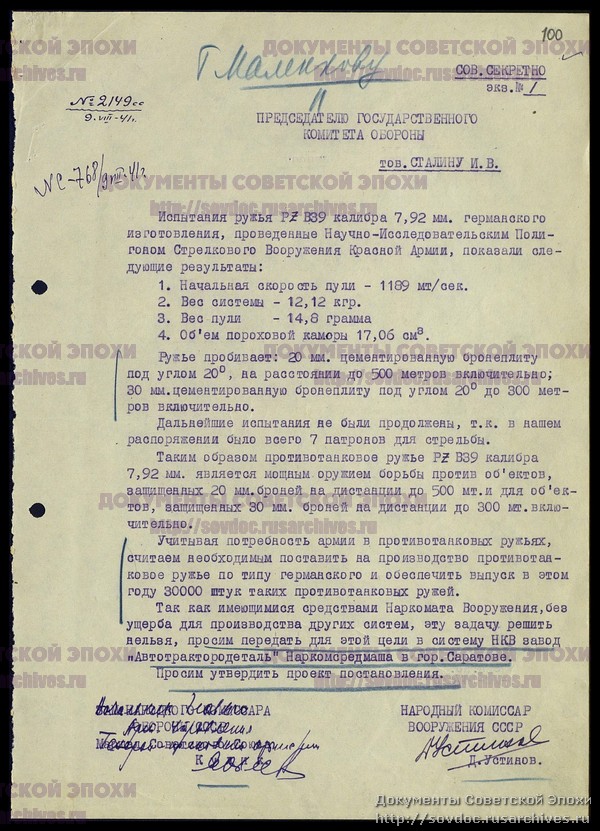
PzB 39 Evaluation


"To the Chair of the State Committee of Defense, comrade I. Stalin

Trials of the German PzB 39 7.92 mm rifle by the Red Army Small Arms Scientific Research Proving Grounds showed the following results:
  1. Muzzle velocity: 1189 m/s
  2. Mass: 12.12 kg
  3. Bullet mass: 14.8 grams
  4. Chamber volume: 17.06 cm^3
The rifle penetrates a 20 mm surface hardened plate at a 20 degree angle from 500 meters and a 30 mm surface hardened plate at a 20 degree angle from 300 meters. Further trials were not performed as only 7 rounds were available for testing.

The PzB 39 7.92 mm rifle can be considered an effective weapon against 20 mm armour at 500 meters and 30 mm armour at 300 meters. Considering the army's need of anti-tank rifles, we consider it necessary to produce at least 30,000 rifles similar to the German one annually. As it is not possible to solve this problem using the resources of the People's Commissariat of Armament without reducing production of other weapons, we ask that the "Avtotraktordetal" factory in Saratov be transferred to the NKV.


People's Commissar of Armament, D. Ustinov."

Sunday, 13 July 2014

Science Fiction

Sometimes, inventions that are sent in to the military seem pretty impressive. Like this one!


"Comrade Lyadov proposes a super-speedy anti-tank rifle, where the propellant burns as fast as possible, and the bullet is propelled primarily through adiabatic expansion of gases. In order to achieve acceptable pressures, the inventor uses low propellant density. With heavy projectiles, the inventor hopes to maximize the Pcp/Pm ratio and achieve muzzle velocity of 3400 m/s.

In order to achieve a chamber large enough, which the inventor says will need to be bigger than the size of the rifled section of the gun, the inventor proposes a two-piece chamber. One of them is a regular chamber, another, connected to the first, is underneath the barrel. The propellant, as can be assumed from the proposal, all fits in the first chamber."

3400 m/s! Pretty impressive. Of course, there is always a catch.


"When evaluating comrade Litvinov's proposal, it must be noted that the aforementioned muzzle velocity (3400 m/s) was obtained after making critical mistakes in the calculations, which makes the ballistic portion of his project a sad misunderstanding."

Saturday, 15 February 2014

Partisan's Companion: The Enemy's Weapons

Earlier, I translated a chapter from the Partisan's Companion dealing with Soviet weapons. This chapter deals with captured German weapons that a partisan group could turn on their previous owners.

"V. Know how to use the enemy's weapons

A partisan must fight not only with weapons adopted by the RKKA, but with the enemy's weapons. Learn to use it, so that you may defeat the German fascists with their own weapons. First, familiarize yourself with the main German small arms.

German Mauser rifle model 1898

Fig. 89. German Mauser rifle model 1898

This rifle is loaded with 5 7.92 mm rounds. It is loaded in the same manner as our rifle, by turning the knob on the right leftwards, and pulling it towards yourself.

The receiver has a slot for a clip with ammunition. The left side of the slot has a groove to press down on the rounds with your finger, pushing them into the magazine.

The rear of the receiver has a flag. In order to put the rifle on safe, raise it. If you turn the flag to the right, the bolt cannot be opened. If you turn the flag to the left, it rifle is ready to shoot.

In order to take out the bolt, turn the handle to the left, use your left thumb to pull back the bolt retainer, and pull the bolt out. When putting it back in, put the extractor above the right groove and pull the bolt retainer to the left.

The sight consists of a front post and a rear sight. The rear sight has four identical scales, measured in meters. Two scales are on the side, and two on the top.

The range of the rifle is 2000 meters. The maximum range of the bullet is 5000 meters.

In order to remove the bayonet, press on the retainer button with your right hand. Fire the rifle without a bayonet. It is mounted on the rifle only in the event of hand to hand combat.

38-40 Submachinegun

Fig 91. 38-40 Submachinegun

The submachinegun has a caliber of 9 mm. A bracket (the stock) is attached to the pistol grip. It can be folded out. This lengthens the SMG, but allows you to fire more comfortably. Here is how to open it: find a button on the left side of the pistol grip, press on it downwards, and the stock will open. 

The end of the stock has a crooked bar that braces on your right shoulder during firing. It is held in place by a mechanical retainer. When you want to open the stock, turn it downwards. Turning it upwards again locks the stock in place. 

Here is how to fire:
  1. Open the stock and shoulder bar.
  2. Brace the bar against your right shoulder.
  3. Grip the pistol grip with your right hand, and the magazine well with your left.
  4. Acquire your target through the sight.
  5. Fire.
Hand Machineguns

All hand machineguns use German and Polish 7.92 mm Mauser rounds.

Know the various Mauser ammunition types

Light bullets have a black rim around the primer. Heavy bullets have a green rim. Armour piercing bullets have a red rim. Incendiary rounds have a black rim, but the tip of the bullet is light or black. Armour-piercing tracer rounds have a red rim, and the tip of the bullet is black.

MG-34 Hand Machinegun

The MG-34 weighs 12 kilograms. Its caliber is 7.92 mm. Effective range is 1100 meters. The machinegun can be fed from a magazine or from a belt. A magazine fits 75 rounds. Belts fit either 250 or 50 rounds. Carefully inspect elements of the the machinegun.

Fig. 92. MG-34 hand machinegun with belt.
Fig 93. MG-34 hand machinegun with magazine.

MG-08/15 and MG-08/18 Machineguns

Rate of fire: 500 RPM. Range: up to 2000 meters. Weight of the MG-08/15 is 17.9 kg, MG-08/18 is 14.5 kg. The design of these machineguns is largely the same as the Maxim machinegun. When dealing with them, follow the directions in NSD-38 "Maxim mounted machinegun model 1910". 

Fig. 102. MG-08/15 machinegun

Fig. 103. MG-08/18 machinegun

Place the ammunition box on a special rail. It can be found on the right side of the gun.

When firing from the MG-08/15, fire in bursts of 7-12 rounds, and 3-5 rounds from the MG-08/18. The latter is air cooled, and therefore you do not need to replace the water or add lubricant to the lubricant reservoir. 

When disassembling, first remove the upper screw, then turn the stock downwards.

MG-13 Hand Machinegun (Dreyse) 

Rate of fire: 550 RPM. Effective range: 1200 meters. Mass: 12 kg. Magazine capacity: 25 rounds.

Fig 104. MG-13 Hand machinegun (Dreyse)

ZB-30 (ZB-26) Hand Machinegun

Rate of fire: 550-650 RPM. Range: 1000 meters. This is the lightest German machinegun, at 9.6 kg. The magazine holds 20 rounds.

Fig. 105. ZB-30 (ZB-26) hand machinegun

S-18 Soloturn Anti-tank Rifle

Rate of fire: up to 10 RPM. Caliber: 20 mm. 

This self-loading rifle is designed to combat tanks, armoured cars, etc. At a distance of 200 meters, its bullet can penetrate 31 mm of armour. The magazine can fit 5-10 rounds. 


Fig. 106. S-18 Soloturn Anti-tank Rifle

Parabellum Pistol

The Parabellum pistol is the personal weapon of all German army officers. It is available in two calibers: 9 mm and 7.65 mm. 

Load the Parabellum: take the slide with your thumb and index finger and pull it down (fig 107). Figure 108 shows how to release the slide.

Fig 107. How to pull back the slide.

Fig 108. How to release the slide.

The safety is located on the left side of the pistol. It has two positions, the upper and the lower. When the lever is in the lower position, the gun is safe, and cannot fire. Move the lever is in the upper position, where it says "fire" in German, and the gun can fire.

Rounds can be fed into the chamber when the safety is in any position. Insert the magazine into the lower part of the handle. A magazine carries 8 rounds. It is automatically locked with a button.

The Parabellum has an effective range of 50 meters. Place its barrel on your bent left hand for stability. The maximum lethal range of the bullet is 300 meters. 

M-34 Hand Grenade

Mass: 310 grams
Explosion range: 3-6 meters
Fragmentation range: 10-15 meters
Throwing range: 35-10 meters

Fig. 109. M-34 hand grenade.
Fig. 110. How to throw the grenade.

The German model 1934 hand grenade (fig 109) is an offensive impact-detonated hand grenade. The grenades are armed by quartermasters and issued to the soldiers this way.

Throwing the grenade (fig. 110)

  1. Take the grenade in your right hand, like in the image.
  2. Put your left index finger into the ring. 
  3. Turn your right hand 90 degrees (so the safety bar clears the safety bracket).
  4. Pull the ring out.
  5. Throw the grenade.
The grenade is harmless until the ring with the safety bar is pulled out. The grenade has two safeties. One is pulled out with the ring, the other falls out while the grenade is in flight. The grenade will explode when it hits an object. It is forbidden to attempt to disarm this grenade.

M-24 Hand Grenade

The M-24 is an offensive timed hand grenade. It consists of a cylindrical case, in which the explosive is stored, and the handle with the firing mechanism. The grenade has a special loop for carrying it. The grenade weighs 500 grams, and has no protective casing.

Here is how to arm the M-24 grenade. Screw the handle off the case. There is a cylindrical opening in the lower part of the firing mechanism. Insert the detonator there.

Carefully screw the handle back into the grenade, avoiding shaking or hitting it. The grenade is armed (fig 111). 

When throwing the grenade, put it in your right hand. With your left hand, unscrew the protective cap from the handle. There you will find a porcelain ball. When swinging the grenade, grab the ball, and pull out the cord (fig 111). Throw the grenade immediately, as it will explode in 4.5-5 seconds.

The range of the grenade is 30-35 meters. The fragments of the grenade fly 10-15 meters. 

Fig. 111. M-24 hand grenade.

How to defuse the grenade? Carefully screw off the handle from the casing. Take out the detonator. Wrap it in paper, cotton, or a rag, and put it in your bag so it is safe from being hit or falling out. Reconnect the handle with the grenade.

Always transport the grenades unloaded. Store and transport the detonators separately. 

Model 1939 Egg-shaped Hand Grenade

This is an offensive timed hand grenade. It weighs 220 grams. 

To prepare this grenade for throwing, extract the fuse with the protective cap from the grenade (shown in figure 112 in the left hand) and inspect the fuse housing. Make sure that it is free from debris. Screw off the safety cap from the distance cylinder (fig 112). Replace it with a detonator. The open part of the detonator may contain wood shavings, cloth fibers, etc. In this case, turn the detonator so that they fall out. If they do not, discard the detonator, as it is unusable. Do not attempt to extract debris from the detonator with any object.

If you have a functioning detonator, slide it on the distance cylinder carefully (fig 113). Then, screw the fuse into the grenade and tighten the nut (fig 114). The grenade is ready for use.

Fig. 112. How to remove the safety cap.
Fig. 113. How to put on the detonator.
Fig. 114. How to tighten the fuse with a nut.

Screw off the safety cap, which remains attached by a cord. Take the grenade in your right hand. Grip the cap with your index and middle fingers, and throw the grenade. Remember that it will detonate 4 seconds after you throw.

Some grenades already have a detonator inserted. Know how to disarm them. Pull the fuse out of the grenade. Carefully take the detonator off and wrap it in a rag. Put the safety cap back on and screw the fuse back into the grenade.

Transport grenades separately from the detonators.

Sunday, 2 February 2014

AA PTRS

I periodically come across aircraft kills credited to AT riflemen, and wonder how such a thing is possible. Turns out, this is how.


Sunday, 17 November 2013

Mallet Time

Here are some document excerpts regarding the PTRD bolt-action anti-tank rifle, that a lot of modern milsurp collectors might feel empathy with.

"Recent reports from the fronts, regions, and armies remark on cases where Simonov and Degtyaryev ATRs do not work
...
Experience shows that when using PTRs in summer conditions, even when maintaining them according to section 1, there are rifles that do not extract freely. In order to continue use of the weapon, authorize soldiers to apply wooden mallets."

"Experimental PTRD from factory #74. 610 rounds were fired in various conditions, and 189 extractions (31%) had to be performed with a mallet. The report stated "This PTRD works unsatisfactorily in any conditions". Another PTRD from the factory earned the review "This PTRD works exceptionally unsatisfactorily in any conditions". Out of 275 shots, 264 needed a wooden mallet (96%).
The third PTRD managed to surpass that result. "The lifetime of the rifle was 43 shots. Every extraction needed the mallet. After extracting the 43rd casing, the bolt handle fell off.""


Monday, 11 November 2013

Lend-Lease Gun Supplies

While flipping through a report on Soviet SPG design, I came across a table of Lend-Lease weapons, including some small arms.

CAMD RF 38-11369-1

The first column is the item name. The following 4 columns are the amounts to be shipped along with vehicles (numerator) and the amounts to be received (denominator). The 6th column is the total sum. The 7th column is the missing number. The items themselves are as follows:

76 mm howitzer
76 mm gun
75 mm gun
57 mm gun
40 mm gun
37 mm AA gun
105 mm mortar
50.8 mm mortar
25.4 mm flare gun
13.97 mm Boys ATR
12.7 mm Browning MG
11.43 mm Thompson SMG
7.92 mm BESA MG
7.7 mm Bren MG
7.62 mm Browning MG

Interestingly enough, the amount of weapons shipped as spares for the vehicles is on a different spreadsheet, and in a different order. In this table, the numerator is how much was received, denominator is how much was distributed, and last column is how many extras they have.


105 mm mortar
50.8 mm mortar
13.97 mm Boys ATR
12.7 mm Browning MG
7.62 mm Browning MG
11.43 mm Thompson SMG
7.92 mm BESA MG
7.7 Bren MG

"The table shows that the spare weapons arrived unevenly. For example, BESA MGs and Thompson SMGs arrived in such amounts as to completely satisfy the need for them, and some remained in warehouses: 419 BESAs and 2872 Thompsons.

12.7 Browning MGs came in insufficient numbers. We only received two spares in this period, and many M4A2 tanks that came back for repairs had to be shipped out without them."

And here is another spreadsheet, for spare barrels. This table also lists delivered and used numbers, with leftovers in the last column.


76 mm howitzer
76 mm gun
75 mm gun
57 mm gun
40 mm gun
37 mm gun
12.7 mm MG
7.62 mm MG
7.92 mm MG
7.7 mm MG
11.43 mm SMG