Thursday, 27 August 2015

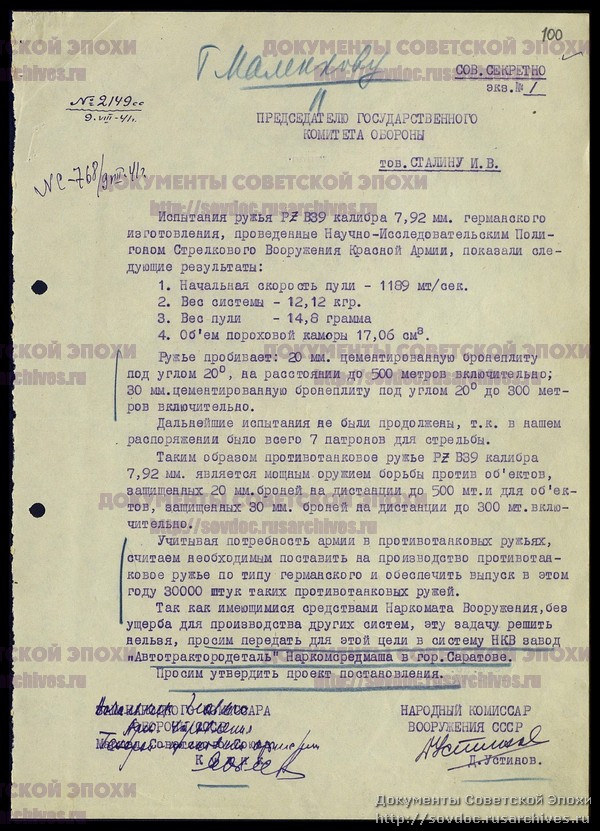
PzB 39 Evaluation


"To the Chair of the State Committee of Defense, comrade I. Stalin

Trials of the German PzB 39 7.92 mm rifle by the Red Army Small Arms Scientific Research Proving Grounds showed the following results:
  1. Muzzle velocity: 1189 m/s
  2. Mass: 12.12 kg
  3. Bullet mass: 14.8 grams
  4. Chamber volume: 17.06 cm^3
The rifle penetrates a 20 mm surface hardened plate at a 20 degree angle from 500 meters and a 30 mm surface hardened plate at a 20 degree angle from 300 meters. Further trials were not performed as only 7 rounds were available for testing.

The PzB 39 7.92 mm rifle can be considered an effective weapon against 20 mm armour at 500 meters and 30 mm armour at 300 meters. Considering the army's need of anti-tank rifles, we consider it necessary to produce at least 30,000 rifles similar to the German one annually. As it is not possible to solve this problem using the resources of the People's Commissariat of Armament without reducing production of other weapons, we ask that the "Avtotraktordetal" factory in Saratov be transferred to the NKV.


People's Commissar of Armament, D. Ustinov."

Sunday, 9 August 2015

The One with the Rifle Shoots

Somehow, the scene from Enemy at the Gates is considered real by some people, but the situation in real life was rather different. Even in blockaded Sevastopol, nobody sent soldiers to the front lines with no rifles.

"Order #03 for the second defense sector, November 19th, 1941
  1. By order of the commander of the 31st Infantry Regiment, 43 rifles were confiscated from rear servicemen of the regiment. 43 soldiers were armed and sent to the front.
I approve of the initiative of the commander of the 31st regiment and order that:
  1. Immediately take inventory of all weapons in the rear forces, leave 1-2 rifles per squad and send the rest to arm the front line troops.
  2. The commandant of the sector HQ must confiscate weapons from rear servicemen, political department, operations department, prosecution, and tribunal.
  3. Immediately confiscate all submachineguns from HQs, regimental and divisional rear servicemen, political department, operations department, prosecution, tribunal, medical units and drivers, send them to:
    1. Regiments: to front line companies and reconnaissance units.
    2. Divisions; to the chief of artillery armament, comrade Oskin.
  4. I must ask commanders and commissars to pay attention to some soldiers that, when the enemy pressures them, retreat and throw down their rifles and even machineguns.
    I demand the strictest responsibility of soldiers and commanders for the weapons given to them. Those that abandon their weapons will be brought before a military tribunal. Form small squads headed by a brave unit commander to retrieve weapons from the dead and heavily wounded in each company. Each rifle and especially machinegun must be saved no matter what."
Via gistory.

Saturday, 20 June 2015

Wonder Bullet

"Act

On July 6th, 1941, based on the orders of the OTB chief, Major of State Security comrade Kravchenko and GAU KA chief, Colonel-General comrade Yakovlev we, [long list of commission members] performed trials of 7.62 mm AP-I bullets with a ceramic-metallic core and gunpowder developed by the OTB NKVD at the OTB NKVD proving grounds to establish their effectiveness.

Experimental rounds of two types were submitted for trials. One type had 4.15 grams of propellant, the other 4.2 grams. Characteristics of the rounds are shown in attachment #3.

Trials were performed against 20 mm surface hardened armour (see characteristics in attachment #1) with the air temperature of 28-29 degrees and range of 100 and 150 meters.

The following bullets were used to test the quality of the armour plate and compare the effectiveness of experimental bullets:

  1. Stock rounds with B-32 bullets.
  2. Rounds with 3.15 grams of propellant and a metallic-ceramic core.
  3. Rounds with 4.2 grams of experimental gunpowder and B-32 bullets.
These bullets were fired at 50 meters, as firing them from larger ranges made no sense due to their ineffectiveness against 20 mm of surface hardened armour from even 50 meters. Results are contained in the following table:


HitsComplete penetrationsIncomplete penetrationsComplete penetrations, part of bullet is stuck% penetrations
Stock round with B-32 bullet5051
0
Experimental round with B-32 bullet5051
0
Experimental round with metallic-ceramic bullet (w=3.15)5052
0
Experimental round with metallic-ceramic bullet (w=4.15)53
2100

213132195.2
Experimental round with metallic-ceramic bullet (w=4.2)53
2100

Notes:
  1. Dents on one side, no effect on the other side.
  2. Three hits caused bulges on the rear side, two had the bullet tip penetrate completely.
  3. The bullet tip penetrated completely.
In order to test the incendiary action of the bullets, experimental rounds (w=4.2) were fired from a range of 150 meters at a 20 mm plate with a full gasoline tank up against it. As a result, the gasoline ignited from the first shot that hit the gasoline (the first shot that was fired hit above the gasoline). Both bullets penetrated the armour completely.

Conclusions
  1. The effectiveness of the experimental OTB NKVD rounds is superior to all currently known 7.62 mm armour piercing incendiary bullets.
  2. The results should be immediately checked at NIPSVO to establish ballistic norms and more carefully establish the armour penetration effectiveness. For this purpose, USV GAU should produce 500 bullets with ceramic-metallic cores by July 6th, 1941, and OTB NKVD must assemble them and send them to NIPSVO by July 7th, 1941.
  3. Due to good results of trials, do not wait for NIPSVO trials to complete and begin production with existing propellant. USV GAU must provide the bullets for this batch. The batch must be complete by July 15th, 1941.
  4. NKO must give the order to NKB for production of the gunpowder developed by the OTB NKVD at factory #40 in the amount of 7-10 tons, and NKV must set up production of 7.62 mm bullets with ceramic-metallic cores at factory #188.
  5. Calculate the propellant load with the aim to produce average pressure less than 3200 kg/cm^2 as both rounds tested had similar results."

Thursday, 19 February 2015

AK Muzzle Devices

The accuracy of an automatic weapon is important, and many experiments were run on the AK platform to figure out if it can be increased. A number of experimental muzzle devices were built for this purpose. _tezka provided this picture.

Left to right: similar to stock type, brake-compensator, two chamber, flash suppressor, single chamber, reactive.

While all of these successfully reduced muzzle climb and improved accuracy, there was one important drawback that engineers did not necessarily consider...

"The positive effect of the muzzle brake on the accuracy is at odds with the negative result of the sound wave hearing, which is greatly increased to unacceptable levels with most muzzle brakes.
...
The evaluation of the effect of the sound waves on hearing reveals that all muzzle brakes in the table result in a bothersome or painful sensation in the ears."

A DShK style reflector was considered to remedy this effect, but...

"...a reflector of such size can hardly be recommended as they decrease the maneuverability and comfort of the weapon and do not achieve the intended result of reducing the sound to a level that does not cause pain."

Another device was tested to improve accuracy, but it was a different kind of brake.


Curiously enough, it was a brake for the bolt. The experiment was meant to determine the effect of the speed of the bolt flying back and forth on accuracy. The knobs on the sides could adjust the force applied to the bolt in order to slow it down.

Sunday, 28 December 2014

AK Precision

"Characteristics of dispersion for Kalashnikov assault rifles (AK-74 and AKS-74)
Bullet with a steel core
Shooting in short bursts, while prone"


The table is split into two sections. The section on the left is for a well trained shooter, the section on the right is for an average shooter. For each section, the dispersion is first given for the first bullet in the burst (height, then width), then for the subsequent bullets. The first two columns in the subsequent section are for the bullet itself. The second two are for the average point of impact between all hits. The last two columns are the total dispersion.

The notes in the bottom remark that the table is also valid for shooting at night, within the range of the night vision scope, and when firing single shots, the dispersion in the first two columns (first bullet of burst) is valid.

Thursday, 30 October 2014

Sturmgewehr Usage

Some of you may have wondered when the Soviets noticed that the Sturmgewehr has joined the arsenal of German infantry. Wonder no more! Via kris-reid:


"To the People's Commissar of Defense, Marshal of the Soviet Union, comrade I.V. Stalin:

Since the Spring of this year, forces of the Kalinin, and then Volkhov and Leningrad Fronts have captured, among other weapons, several specimens of new German automatic 7.92 mm carbines, which are a new type of infantry weapon that has not been previously used by the Germans in large amounts until recently."

The date on this document is April 16th, 1943. Here's the intel obtained on this mysterious weapon:


"Enemy tactics and technology
Engineer-Captain Ya. Krutik

1. New German handheld machinegun

The German army has recently adopted a new handheld machinegun, using an intermediate round (an average between a rifle round and a pistol round). The machinegun's designation is "MK belash 42 (H)". The automatic mechanism is driven by redirection of gases through an opening in the barrel.

The machinegun can fire automatically or in single shots, for which a switch is present in the trigger guard, next to the pistol grip.

The machinegun is fed with a box magazine, which holds 35-38 rounds.

  • Caliber: 7.9 mm
  • Length: 935 mm
  • Mass: about 5 kg
  • Round mass: 16.8 g
  • Bullet mass: 8.2 g"
The translator was a little presumptuous. "MKb" stands for Maschinen Karabiner, or machine carbine. Also, the magazine capacity has grown somewhat from the 30 rounds it actually contained. Otherwise, this intelligence is correct.

Saturday, 25 October 2014

High Capacity

I am sure that many of you have seen those comedic 100-round magazines for AK assault rifles that can barely feed 5 or 6 without jamming up. What you probably didn't know is that the idea isn't exactly new.


These photos are from magazine trials of 30, 40, 50, and 100 rounds.